Ladakh Spring Trip 2026 — Your Complete Guide to the Land of High Passes in Bloom
Apricot blossoms in the desert, empty roads to Pangong, and Himalayan silence before the summer crowds arrive. Here is everything you need to plan the perfect Ladakh spring trip.
1. Why Spring Is the Best Season for Ladakh
The Season That Most Travellers Overlook
Most people plan their Ladakh trip for July or August. Consequently, they arrive to find roads clogged, hotels fully booked three months in advance, and queues at every viewpoint from Pangong Lake to Khardung La. Spring — specifically March and May — offers a completely different experience. In fact, a spring Ladakh trip may well be the finest version of Ladakh available to a traveller today.
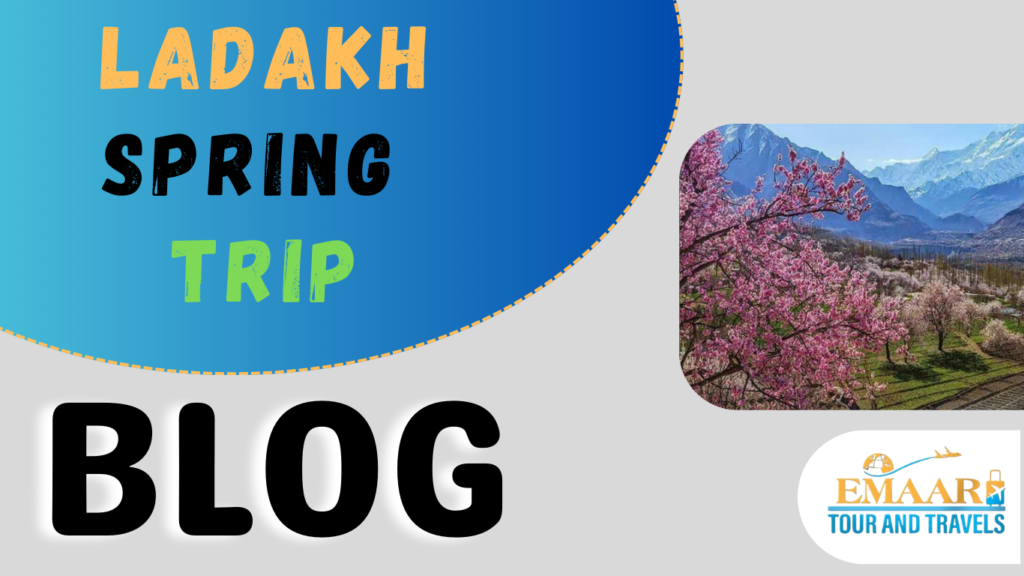
The reason, furthermore, is simple: Ladakh in spring is Ladakh before it is discovered. The roads from Srinagar open in April, the apricot trees across the valley burst into white and pink bloom, and the monasteries hold their most significant festivals in a landscape still dusted with snow. Above all, the silence is extraordinary — a vast, mineral silence that the summer crowds erase entirely.
Five Reasons to Choose Spring Over Summer
2. Ladakh Spring Weather — What to Expect
Understanding Ladakh’s Unique Climate
Ladakh sits in a high-altitude rain shadow, which means it receives very little precipitation compared to the rest of the Himalayan region. In spring, this creates a distinctive climate: bright, sharp days with intense sunshine and deep blue skies, followed by bitterly cold nights. Specifically, the temperature in Leh in April ranges from approximately -2°C at night to 14°C in the afternoon. By May, nights warm to around 4°C and days reach 18°C.
Furthermore, the UV index at altitude is extreme even in spring — sunburn can occur within 20 minutes of unprotected exposure at 3,500 metres. Therefore, sunscreen and UV-protective eyewear are not optional items; they are as essential as a warm jacket. In addition, while snowfall is possible in April at the higher passes, the main Leh–Manali and Leh–Srinagar routes are typically navigable by mid-April.
Spring Weather Month by Month
| Month | Day Temp | Night Temp | Road Status | Conditions |
|---|---|---|---|---|
| March | 5°C – 10°C | -8°C – -4°C | Srinagar–Leh may open late March. Manali–Leh closed. | Early spring, cold nights, snow at passes |
| April | 10°C – 14°C | -2°C – 2°C | Srinagar–Leh open. Manali–Leh remains closed. | Apricot bloom, clear skies, light crowds |
| May | 15°C – 20°C | 4°C – 8°C | Both highways open by mid-May. Flights daily. | Best spring month — all roads, warm days, still uncrowded |
| June | 20°C – 26°C | 8°C – 12°C | Fully open — summer season begins. | Warm, increasingly busy — summer begins |
The Best Spring Month — Our Expert Recommendation
3. Top Places to Visit in Ladakh in Spring
The Destinations That Define a Spring Ladakh Trip
Ladakh’s geography is extraordinary in every season, but spring adds a layer of visual drama that summer cannot match. The following six destinations are, in our experience, non-negotiable for a spring visit. Each one offers something specifically enhanced by the season — whether that is a monastery festival, blossom-covered orchards, or a glacial lake in the first week of its thaw.
Leh — The Desert Capital
Leh is both the starting point and the heart of any Ladakh trip. At 3,500 metres, it sits beneath a 9th-century palace, surrounded by whitewashed monasteries and poplar-lined streets that, in April, are framed by apricot blossom. The Leh Palace viewpoint at sunrise — when the surrounding peaks turn rose-gold and the valley below is still in shadow — is, specifically, one of the finest views in the entire Indian Himalayan region.
Furthermore, Leh’s market area and old town are richly atmospheric in spring before the tourist shops fully open. The Jama Masjid, the Shanti Stupa, and the narrow lanes of the old bazaar are therefore best experienced in April and early May, when they belong to the local community rather than the tourist season. In addition, Leh serves as the acclimatisation base for every traveller arriving by air — consequently, spending two full days here before venturing to the high passes is not just recommended but medically essential.
🏛️ Monastery 🌸 Apricot Blossom 🌄 Palace Viewpoint 🧘 AcclimatisationPangong Lake — The Blue Mirage
Pangong Tso — at 4,350 metres and stretching 134 km across the India–China border — is arguably the most photographed location in Ladakh, and for good reason. The lake’s colour shifts through the day from pale turquoise to deep cobalt to sapphire, depending on the angle of the light and the reflection of the sky. In spring, moreover, the lake is in its early thaw — portions of it still frozen in April, completely open by May — which creates ice-edge photography conditions that are entirely unique to this season.
Specifically, the drive from Leh to Pangong (approximately 150 km, 4–5 hours) crosses the Chang La pass at 5,360 metres, offering one of the most dramatic road journeys in the world. As a result, most visitors who make the trip consider Pangong Lake the highlight of their entire Ladakh experience. We operate day tours and overnight camping packages to Pangong throughout the spring season.
💧 Alpine Lake 🧊 Spring Ice Edge 📸 Photography 🏕️ Lakeside CampingNubra Valley — The Valley of Flowers in Spring
Nubra Valley, accessed via the legendary Khardung La pass (5,359 metres — one of the world’s highest motorable roads), is a wide, surprisingly green valley at 3,048 metres. In spring, the valley floor is carpeted with wildflowers and the apricot orchards of Hundar and Diskit villages are in full bloom — a visual contrast against the stark, sand-dune desert landscape that is almost surreal in its beauty.
Furthermore, Nubra is home to the Bactrian (double-humped) camels of the Silk Road, which still roam the dunes near Hundar and can be ridden on short excursions. In addition, the Diskit Monastery — watching over the valley from a high ridge — houses a 32-metre Maitreya Buddha statue that, when seen against a spring sky with snow still on the peaks behind it, creates one of the most striking images available anywhere in India.
🐪 Bactrian Camels 🌸 Apricot Orchards 🏛️ Diskit Monastery 🏔️ Khardung LaThree More Spring Destinations Worth Including
Hemis Monastery — The Largest Gompa in Ladakh
Hemis is the largest and wealthiest monastery in Ladakh and, consequently, the most architecturally impressive. Located 45 km from Leh in a hidden gorge, it is home to the Hemis Festival — a two-day masked dance celebration held in early spring that attracts visitors from across the Buddhist world. Specifically, the Cham dance performances, where monks dressed in elaborate costumes enact ancient spiritual narratives in the monastery courtyard, are one of the most vivid cultural experiences available anywhere in the Himalayan region.
Furthermore, even outside festival season, Hemis is worth a half-day visit in spring. The monastery museum holds remarkable 17th-century thangka paintings, ancient weapons, and silver relics. In addition, the surrounding gorge is beautiful in April — dry, austere, and wrapped in a silence that feels genuinely ancient.
🎭 Hemis Festival 🏛️ Largest Gompa 🎨 Thangka ArtThiksey Monastery — The Little Potala
Thiksey is the monastery most often compared to Tibet’s Potala Palace — a twelve-storey complex of white and ochre buildings stacked dramatically on a hillside 19 km from Leh. In spring, the monastery’s morning prayer ceremony at 6:00 am is one of the most atmospheric experiences in Ladakh — the sound of horns and drums echoing across the still, cold valley while the peaks behind slowly catch the first light of day.
Moreover, Thiksey houses a remarkable 15-metre Maitreya Buddha statue that fills an entire two-storey chamber. Therefore, it is, above all, a place worth visiting not merely as a viewpoint but as a living, functioning monastery community. Accordingly, visitors are always welcome to observe the morning prayers with respectful silence.
🌅 Morning Prayer 🏛️ Hillside Monastery 📸 ArchitectureMagnetic Hill & Confluence Point
Magnetic Hill — located 30 km west of Leh on the Leh–Kargil highway — is a fascinating optical illusion where the landscape’s orientation makes stationary vehicles appear to roll uphill. While the science is well-understood, the experience of parking on the marked spot and watching your vehicle inch forward is, in fact, surprisingly compelling. In spring, the surrounding landscape of sand-coloured hills and distant snowfields is at its starkest and most photogenic.
Furthermore, just a few kilometres away, the Zanskar and Indus rivers meet at Sangam — a confluence point where the two rivers run side by side without mixing, their different sediment loads creating a vivid two-toned river visible from the road above. Specifically, the teal-grey of the Zanskar against the brown-green of the Indus is one of spring Ladakh’s most striking natural colour contrasts.
🧲 Magnetic Hill 🌊 River Confluence 📸 Natural Phenomena4. Best Spring Activities in Ladakh
What You Can Do That Summer Visitors Cannot
Spring opens a set of activities in Ladakh that are either unavailable or significantly less rewarding in summer. Consequently, understanding these season-specific experiences is important when planning your itinerary. The following activities are, specifically, at their best between April and May.
Activities by Month — When to Do What
| Activity | March | April | May |
|---|---|---|---|
| Apricot Blossom Walk | Not yet | Peak bloom | Late bloom |
| Pangong Lake Visit | Partially frozen | Thawing — dramatic | Fully open |
| Nubra Valley via Khardung La | Pass may be closed | Opens mid-April | Fully open |
| Zanskar River Rafting | Not available | Early season | Peak conditions |
| Monastery Festivals | Some festivals active | Dosmoche, Hemis | Check local calendar |
| Cycling — Khardung La | Road closed | Opens late April | Best conditions |
5. 7-Day Ladakh Spring Itinerary
How This Itinerary Was Designed
This 7-day plan is designed specifically for a May visit — therefore, all roads and passes are assumed to be open. The first two days are dedicated entirely to acclimatisation in Leh, which is, above all, the most important decision you can make for a high-altitude trip. Skipping the acclimatisation period to rush to the passes is the single most common mistake that results in altitude sickness and ruined trips. In addition, the itinerary is designed to move from lower to higher altitudes progressively, which further reduces altitude risk.
Days 1 and 2 — Leh Arrival and Acclimatisation
- MorningArrive Leh by flight. Check into your hotel and rest immediately. Specifically, spend the first 4–6 hours lying down or sitting quietly — do not walk around, do not carry luggage up stairs, and do not explore. Drink at least 3 litres of water throughout the day. Your body needs this time to begin adjusting to the 3,500-metre altitude.
- AfternoonShort 20-minute walk only. If you feel comfortable in the late afternoon, a gentle 15–20 minute walk near the hotel is acceptable. However, avoid the old town stairs, the Shanti Stupa climb, or anything that elevates your heart rate significantly. Furthermore, eat light — a soup and rice meal is ideal for the first evening.
- EveningEarly sleep. Aim to be in bed by 9:00 pm. Sleep is the most effective acclimatisation tool available. In addition, keep your room warm — temperatures drop below zero overnight in Leh even in May, and cold stress compounds altitude stress.
- 7:00 AMThiksey Monastery morning prayer. If you feel well rested, the 6:00–7:30 am prayer ceremony at Thiksey (19 km from Leh) is one of the finest experiences in Ladakh. The drive there in a warm vehicle is easy, and the ceremony involves no physical exertion. Moreover, the sunrise light on the monastery at this hour is exceptional for photography.
- 10:00 AMShey Palace and Hemis Monastery. Both are within 45 km of Leh and involve minimal walking. Specifically, Hemis’s courtyard and museum can be explored comfortably in 2–3 hours. Return to Leh for lunch. Avoid climbing steep monastery stairs quickly — take them slowly and rest as needed.
- 3:00 PMLeh old town walk. A gentle stroll through the old bazaar and apricot-blossom lanes of the old town. In addition, visit the Leh Palace viewpoint at a comfortable pace — the views over the valley and towards the snow-covered Stok Kangri peak are consequently among the finest in the region. Rest and hydrate well before dinner.
Days 3 to 5 — Pangong, Nubra and High Passes
- Day 3, 7 AMDepart Leh for Pangong. The 150 km drive via Chang La pass (5,360m) takes approximately 4–5 hours. Specifically, the Chang La crossing is the highest point of the trip and requires a short acclimatisation stop at the top — 10 minutes out of the vehicle and no running. The descent into the Pangong basin is, in fact, one of the most dramatic drives in Asia.
- Day 3, NoonFirst sight of Pangong Tso. In May, the lake is fully thawed and at its most vivid blue-green. Check into your lakeside camp. The afternoon is entirely free — consequently, use it to walk along the shoreline, photograph the changing light, and absorb the silence. This is, above all, what a Ladakh spring trip is for.
- Day 3, NightStargazing at Pangong. After dinner, the sky above Pangong on a clear May night is one of the finest in the world. The Milky Way is visible to the naked eye. Furthermore, at 4,350 metres with zero light pollution, astrophotography conditions are extraordinary. Warm clothing is essential — temperatures fall to -5°C at the lake at night even in May.
- Day 4, DawnSunrise at the lake. Wake before sunrise and walk to the water’s edge. The lake at first light — still, perfectly reflective, and turning from black to gold to blue as the sun clears the surrounding ridges — is, in our experience, the single most memorable moment of a Ladakh trip. Return to Leh via the same route by afternoon.
- 7:00 AMDepart Leh for Khardung La (5,359m). The pass is typically open by 9:00 am. Specifically, stop at the top for 10–15 minutes, take your photographs, and descend — do not linger, as the altitude at the summit is extreme. Moreover, the descent into Nubra is extraordinary — the valley below appears suddenly and impossibly green against the surrounding brown Himalayan desert.
- 11:00 AMArrive Diskit, Nubra Valley. Visit the Diskit Monastery and the 32-metre Maitreya Buddha overlooking the valley. Furthermore, walk through the apricot orchards below the monastery in April and May — the contrast of pink blossom against the bare, sand-coloured hills is one of spring Ladakh’s defining images.
- 2:00 PMHundar Sand Dunes — Bactrian Camel Ride. The double-humped Bactrian camels of Nubra are one of Ladakh’s most unexpected sights. Specifically, a short 20-minute camel ride across the sand dunes with the snow peaks above is an experience available nowhere else in India. Return to Leh over Khardung La by evening.
Days 6 and 7 — Final Leh Exploration and Departure
- 8:00 AMDrive west along the Indus. The road from Leh towards Kargil follows the Indus River through a landscape of sand-coloured gorges and unexpected green villages. Specifically, the drive itself is one of the most cinematic in Ladakh — consequently, leave early to catch the best morning light.
- 10:00 AMMagnetic Hill and Sangam. Stop at Magnetic Hill for the optical illusion experience, then drive a few kilometres further to the Zanskar–Indus confluence. The two rivers — running side by side without mixing, their contrasting colours forming a vivid natural divide — are, in fact, one of the most photographed natural phenomena in all of Ladakh.
- 1:00 PMAlchi Monastery. Alchi is Ladakh’s oldest monastery, dating to the 10th century, and houses the finest examples of early Kashmiri Buddhist murals in the region. Furthermore, the monastery’s location beside the Indus in a poplar grove — particularly beautiful in spring — makes it one of the most peaceful spots in Ladakh. Return to Leh for the evening.
- 5:30 AMShanti Stupa at dawn. The white stupa on the hill above Leh at sunrise — with the entire town, the palace, and the snow peaks behind catching the first gold light — is the finest panoramic view in Leh. Therefore, set your alarm for 5:00 am on your last morning and walk up (approximately 20 minutes). You will not regret it.
- 9:00 AMLeh main bazaar. The market opens early and is, specifically, the best place to buy Ladakhi handicrafts, pashmina scarves, thangka prints, apricot products (oil, jam, dried fruit), and Tibetan jewellery. Moreover, the pashmina sold here is of significantly better quality and authenticity than what is available in Srinagar or Delhi.
- AfternoonTransfer to Leh airport. Departures from Leh Kushok Bakula Rimpochee Airport are typically in the morning or early afternoon — check your specific flight time accordingly. As a result, plan your bazaar visit to finish by late morning if your flight departs in the early afternoon.
6. How to Reach Ladakh in Spring
By Air — The Most Reliable Spring Option
Flying to Leh Kushok Bakula Rimpochee Airport is, specifically, the recommended way to arrive in spring — particularly in March and April when the road highways may still be partially open. IndiGo, Air India, SpiceJet, and Go First operate daily flights from Delhi, Srinagar, Chandigarh, and Jammu. Furthermore, the flight itself is spectacular — the approach to Leh over the Karakoram peaks is one of the finest aerial views in Asia. Consequently, book a window seat on the left side of the aircraft when flying from Delhi for the best views of the Himalayas.
One important note: Leh airport is subject to weather cancellations, particularly in early spring when visibility can be limited. Therefore, always build a buffer day into your itinerary on both the arrival and departure end. In addition, fly in the morning — afternoon flights to Leh have a significantly higher cancellation rate due to wind conditions.
By Road — Srinagar–Leh Highway (NH1)
The Srinagar–Leh Highway is the first road to open in spring, typically by mid-March to early April depending on snowfall. Specifically, this 434 km route through Kargil, Drass, and the Zoji La pass is one of the most beautiful road journeys in India — passing through deep gorges, ancient villages, and high passes before emerging into the Indus Valley above Leh. Moreover, the road passes through Kargil, the second-largest town in Ladakh, which makes an excellent overnight stop on the two-day drive.
The Manali–Leh Highway (474 km) generally opens in mid-May. Consequently, it is not an option for April visits but becomes available by the second half of May. This route crosses five high passes including the Baralacha La (4,890m) and Tanglang La (5,328m) and is, above all, one of the great road trips of the world — however, it requires a full two days minimum and a reliable, high-clearance vehicle.
By Road — Key Facts
7. Altitude Safety — The Essential Guide
Understanding Altitude Sickness in Ladakh
Altitude sickness — medically known as Acute Mountain Sickness (AMS) — is the most important safety consideration for any Ladakh trip, regardless of your age, fitness level, or previous travel experience. Specifically, Leh sits at 3,500 metres, and key attractions like Chang La and Khardung La exceed 5,300 metres. At these elevations, the air contains approximately 50% less oxygen than at sea level. Consequently, every traveller — including fit young athletes — is at risk of AMS if they do not acclimatise correctly.
⚠️ The Four Non-Negotiable Altitude Rules
Rule 1 — Rest on Day 1: No strenuous activity, no high passes, no rapid ascent on your first day in Leh. This rule applies to every traveller without exception.
Rule 2 — Hydrate constantly: Drink a minimum of 3–4 litres of water per day in Ladakh. Dehydration accelerates AMS. Furthermore, avoid alcohol entirely for the first two days.
Rule 3 — Ascend gradually: Never ascend more than 500 metres per day above 3,000 metres. Consequently, if you are driving up from Manali, plan overnight stops at intermediate altitudes.
Rule 4 — Descend if symptoms worsen: Headache, nausea, and fatigue are early AMS symptoms. If these do not resolve after rest, descend immediately. Specifically, descent is the only reliable treatment for severe AMS.
Diamox — What You Need to Know
Acetazolamide (Diamox) is a prescription medication that assists acclimatisation by stimulating faster breathing. Many Ladakh travellers take it preventively. However, it is important to consult a doctor before taking Diamox, as it has contraindications — specifically, it should not be taken by anyone with a sulfa drug allergy. In addition, Diamox has common side effects including increased urination and tingling in the fingers, which are normal and not a cause for concern. We recommend discussing this option with your GP at least two weeks before your departure date.
Who Should Take Extra Care
While Ladakh is accessible for travellers of all ages and backgrounds, certain groups should take additional precautions. Specifically, people with pre-existing heart or respiratory conditions, pregnant travellers, and those who have previously experienced severe AMS should consult a doctor before booking a Ladakh trip. In addition, older travellers and very young children acclimatise more slowly than young adults and therefore need a more gradual ascent schedule. Furthermore, fitness level is not a reliable predictor of AMS resistance — in fact, very fit athletes sometimes acclimatise more poorly because they are more inclined to push through early symptoms.
8. Ladakh Spring Packing Checklist
What Makes Spring Packing Different
Packing for a spring Ladakh trip requires a dual approach — warm enough for nights that drop below zero and high-pass crossings at 5,300 metres, but also light enough for sunny afternoons when temperatures reach 18°C in Leh. Specifically, the layering system is the most effective strategy: base layer, mid layer, and outer shell, which can be added or removed as conditions change through the day. In addition, UV protection is, above all, the most commonly underestimated requirement — the combination of high altitude and spring sunshine creates burning conditions far more intense than at sea level.
The Complete Spring Packing List
9. Frequently Asked Questions — Ladakh Spring Trip
Questions Our Guests Ask Before Every Spring Departure
🌸 Ready for Your Ladakh Spring Adventure?
Our local experts handle everything — permits, acclimatisation planning, accommodation, and private transport — so you can simply enjoy Ladakh in bloom.
📞 Book Your Ladakh Spring TripAbout the Author: This guide was written by the travel specialists at Emaar Tour and Travels, a Srinagar-based tour operator with over six years of experience guiding visitors across Jammu and Kashmir and Ladakh — including dozens of spring Ladakh expeditions every April and May. Visit us at emaartourandtravels.in to plan your journey.