Kashmiri Cuisine — 10 Must-Try Dishes in Srinagar
From slow-cooked Rogan Josh to a cup of rose-pink Noon Chai at dawn — a local guide to the flavours that define Kashmir, written by people who have eaten at every table in the valley.
1. Introduction — The Cuisine That Tells Kashmir’s Story
More Than Food — A Living Cultural Archive
Every great regional cuisine is, in essence, a map of the place it comes from — shaped by geography, trade routes, religion, and the long accumulation of a people’s tastes and memories. Kashmiri cuisine is, therefore, one of the richest maps in India. It is a cuisine formed at the crossroads of Central Asian, Persian, Mughal, and indigenous Kashmiri traditions, layered over three thousand years in a valley surrounded by the highest mountains on earth.
What this means in practice is that eating in Srinagar is not merely an act of sustenance — it is an act of cultural immersion. Specifically, the slow-cooked lamb of a Rogan Josh carries the memory of Persian caravans. The fragrant Kashmiri Pulao bears the fingerprints of Mughal court kitchens. And a morning cup of Noon Chai — the extraordinary rose-pink salted tea — is an experience so particular to Kashmir that it cannot be found, in this form, anywhere else on earth. Furthermore, the Wazwan tradition, in which hereditary master chefs prepare feasts of up to thirty-six courses for weddings and celebrations, represents one of the last intact living examples of medieval Islamic banquet culture in the subcontinent.
Two Distinct Traditions Within One Cuisine
It is important to understand, before diving into the dishes themselves, that Kashmiri cuisine is not a single tradition but two parallel ones: the Kashmiri Muslim tradition and the Kashmiri Pandit tradition. Both share the same foundational spice palette and many of the same techniques. However, they diverge in significant ways — most notably, the Pandit tradition traditionally avoids onion and garlic, relying instead on asafoetida (hing) and fennel to create depth of flavour. Consequently, the two traditions have developed distinct versions of many dishes that are simultaneously familiar and different from each other. In this guide, we cover dishes from both traditions so that every visitor — regardless of dietary preference — can find a full and satisfying Kashmiri food experience.
2. Understanding the Wazwan Tradition
The Greatest Feast in the Indian Subcontinent
The Wazwan is the most important culinary institution in Kashmir and, consequently, the starting point for understanding everything else about Kashmiri food. The word “Wazwan” combines “Waz” — meaning cook or chef — and “Wan” — meaning shop or place. Therefore, at its most literal, it means “the cook’s place.” In practice, however, it describes an elaborate multi-course feast prepared by Waza, the hereditary master chefs whose culinary knowledge is passed from father to son across generations.
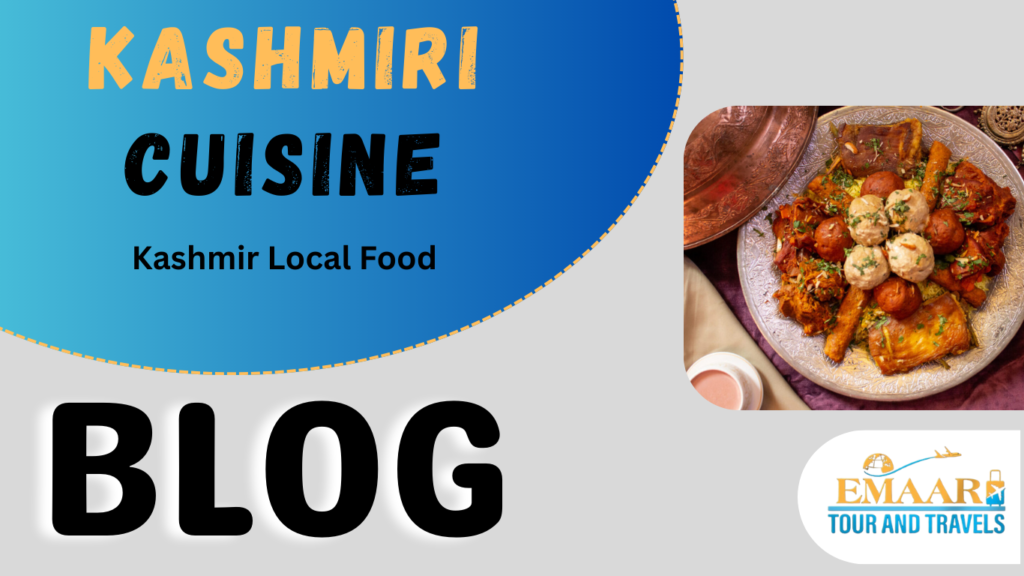
A full Wazwan can include up to thirty-six courses, although most contemporary wedding feasts serve between twelve and twenty dishes. Specifically, the feast is served on large copper platters called “traem”, shared between four guests seated together on the floor. The meal begins with rice, followed by course after course of meat dishes — lamb forms the centrepiece, prepared in a remarkable variety of ways. Above all, the Wazwan is a demonstration of hospitality, and a host who serves a fine Wazwan is conferring the highest honour possible on their guests.
Key Wazwan Courses — What Appears on the Traem
🍽️ A Traditional Wazwan — The Classic Sequence
3. The 10 Must-Try Dishes in Srinagar
How We Chose These Ten
This list was assembled not from cookbooks but from years of eating across Srinagar — at wedding feasts and street stalls, at family dining tables and old-city dhabas. Consequently, these ten dishes represent the widest range of Kashmiri culinary experience available to a visitor: meat and vegetarian, feasting and street food, ancient and contemporary, savoury and sweet. In addition, we have included specific notes on what to look for in a well-prepared version of each dish, so you can tell the difference between a genuinely excellent plate and a tourist-diluted one.
Rogan Josh is, without question, the most internationally recognised dish of Kashmiri cuisine — and it is also, consequently, the dish most frequently misrepresented outside the valley. The name comes from Persian: “Rogan” meaning oil or fat, and “Josh” meaning heat or passion. Therefore, at its most literal, it describes a dish cooked with intensity in its own rendered fat. The result — when prepared correctly — is lamb of extraordinary tenderness, in a sauce of deep brick-red that stains the rice and coats the palate with warmth long after the last mouthful.
Specifically, authentic Kashmiri Rogan Josh derives its colour not from tomatoes (as many restaurant versions outside Kashmir incorrectly use) but from two traditional sources: Kashmiri red chilli, which has a mild and fruity heat rather than a sharp burn, and dried cockscomb flowers (mawal), which deepen the colour further. Furthermore, the aromatic profile comes from whole spices — bay leaf, cardamom, cinnamon, and cloves — ground together and added at the beginning of cooking. The result is a curry that is intensely fragrant, moderately spiced, and deeply satisfying in a way that no outside imitation quite manages.
If Rogan Josh is the most famous Kashmiri dish to the outside world, Gushtaba is the most revered within it. Served as the ceremonial final course of a Wazwan feast, its arrival at the table signals the end of the meal — specifically, guests should stop eating other dishes once the Gushtaba appears, as consuming it is considered the completion of the feast. In this sense, Gushtaba holds a cultural weight that goes far beyond its ingredients.
The dish consists of large meatballs — made from hand-pounded lamb meat (not minced, which is a crucial distinction) mixed with lamb fat and spices — poached in a silky, aromatic yoghurt-based sauce perfumed with fennel, cardamom, and dried ginger. Moreover, the hand-pounding technique, which takes an experienced Waza up to an hour per batch, produces a texture that no machine can replicate: dense yet yielding, with a clean lamb flavour that comes through the sauce. Consequently, a well-made Gushtaba is one of the most sophisticated meat preparations in the entire Indian culinary tradition.
Yakhni is Rogan Josh’s pale, quieter counterpart — a white yoghurt lamb curry that is, in many ways, the more technically demanding of the two. Where Rogan Josh announces itself with colour and depth, Yakhni achieves its effect through restraint. The sauce is a smooth, ivory-white yoghurt base infused with fennel seeds, dry ginger powder, and whole cardamom, with no chilli and no onion in the traditional Pandit version. Furthermore, the cooking technique requires constant stirring to prevent the yoghurt from splitting — a sign of a skilled Waza’s patience and attention.
The flavour of a well-made Yakhni is, specifically, one of the most elegant things Kashmiri cuisine produces: clean, fragrant, slightly sour from the yoghurt, with the anise-like sweetness of fennel running through it. As a result, it provides a beautiful contrast to the richer, spicier dishes on a Wazwan platter. In addition, Yakhni is one of the most approachable dishes for visitors who prefer a milder experience — it carries all the complexity of Kashmiri cooking without the chilli heat.
Tabak Maaz is the dish that Wazwan guests remember most vividly — large, meaty lamb ribs that are first slow-cooked in milk and whole spices until completely tender, then shallow-fried in ghee until the exterior is crisp and golden while the meat inside remains impossibly soft. The contrast of textures — the shatter of the fried exterior giving way to yielding, aromatic meat — is, specifically, the kind of thing that makes experienced food travellers go quiet at the table.
The preparation is lengthy and therefore labour-intensive, which is why Tabak Maaz is firmly a celebratory dish rather than a casual one. Furthermore, the quality of the lamb matters enormously — the dish was traditionally made with the ribs of grass-fed Kashmiri sheep, whose meat has a richness and sweetness that commercial lamb cannot match. Consequently, the finest Tabak Maaz in Srinagar is found not in the tourist restaurants of Dal Lake but in the old-city establishments that source their meat from traditional butchers in the Maharaj Gunj market.
Kashmiri Dum Aloo is, above all, the dish that makes vegetarian visitors reassess everything they thought they knew about potato curry. It bears almost no resemblance to the Dum Aloo found in North Indian restaurants elsewhere in the country. Specifically, the Kashmiri version uses small whole baby potatoes — pricked and deep-fried first until golden, then slow-cooked (“dum”) in a yoghurt and Kashmiri red chilli sauce that is simultaneously earthy, fragrant, and gently hot in a way that builds slowly rather than hitting immediately.
Furthermore, the Pandit version of Dum Aloo adds fennel powder and dried ginger as the primary aromatics in place of onion and garlic — producing a flavour profile that is distinctly Kashmiri and unlike anything else in Indian cuisine. In addition, the texture of the potato after slow-cooking in the sealed pot absorbs the sauce completely, resulting in each piece being flavoured all the way through. Therefore, this is a dish that rewards those who take their time with it rather than eating quickly. It is, in short, comfort food elevated to an art form.
Haak is the Kashmiri name for collard greens, and Haak Saag — these greens cooked in mustard oil with a whole dried red chilli and nothing else except water and salt — is the most deceptively simple dish in the entire Kashmiri culinary tradition. It is, moreover, the dish that Kashmiri people themselves identify most deeply with home. Specifically, while Rogan Josh is what Kashmir is famous for, Haak Saag is what Kashmiris actually eat most often and feel most nostalgic about when they are away from the valley.
The preparation is deliberately minimal: the greens are cooked in mustard oil until wilted, then simmered in water until tender, with the bitter edge of the raw greens transforming into something clean, earthy, and mildly pungent. Consequently, the quality of the dish depends entirely on the quality of the greens — the Haak grown in the gardens of the Kashmir Valley has a flavour that the same variety grown elsewhere does not replicate. In addition, Haak Saag is almost always served alongside rice and a meat dish as part of a daily Kashmiri meal, which makes it the truest window into everyday domestic cooking in the valley.
Noon Chai — “noon” meaning salt in Kashmiri — is the most distinctive beverage in all of South Asian tea culture and, consequently, one of the most surprising first tastes for any visitor. It is a tea made from a special green tea leaf (Qehwa base) brewed with baking soda, then vigorously aerated by pouring repeatedly between vessels until it turns a deep pink, then finished with salted full-fat milk and optionally topped with crushed pistachios and almonds. The result is a tea that is simultaneously savoury, creamy, slightly nutty, and a vivid rose-pink colour that looks more like a fashionable café drink than a centuries-old Himalayan tradition.
Specifically, the pink colour comes from the chemical reaction between the baking soda (which makes the brew alkaline) and the tea’s natural compounds when air is introduced during the pouring process — a reaction that every Kashmiri grandmother understands instinctively but that food scientists have only recently studied formally. Furthermore, Noon Chai is not merely a drink but a social institution: it is served at every Kashmiri gathering, gifted to guests, and consumed from the samavar — the traditional brass urn — at dawn throughout the valley. Therefore, drinking Noon Chai in Srinagar on a cold morning is, above all, an experience that no description fully prepares you for.
Kashmiri Pulao is the dish that most eloquently expresses the Persian and Central Asian heritage of Kashmiri cooking. Long-grain Basmati rice is cooked in a fragrant broth infused with saffron — the kind grown in the Pampore fields just outside Srinagar, which is among the finest and most expensive saffron in the world — and layered with fried dry fruits including raisins, cashews, and dried apricots, along with whole spices and sometimes fresh pomegranate seeds. Moreover, fried onions are piled on top and the entire preparation is sealed and slow-cooked until each grain of rice is separate, golden, and perfumed.
The combination of sweet (from the dried fruit and saffron), savoury (from the spices and salt), and the slight crunch of the nuts creates a flavour experience that is both complex and immediately approachable. Consequently, Kashmiri Pulao is one of the most accessible dishes in the cuisine for first-time visitors, appealing equally to those who love sweet-savoury combinations and those who simply want to understand what the world’s finest saffron actually tastes like in its most natural setting. In addition, it is entirely vegetarian, making it an ideal introduction to the cuisine for visitors across all dietary preferences.
Seekh Kebab is the only Kashmiri dish that crosses freely between the Wazwan feast and the street corner — equally at home on the Waza’s ceremonial platter and sizzling over charcoal on a cart near the Dal Lake embankment at seven in the evening. The Kashmiri version is specifically distinguished from its counterparts elsewhere in India by its spice profile: fennel seed, dried ginger, and Kashmiri chilli give it a warm, anise-forward flavour that is distinctly local rather than generic tandoor.
Furthermore, the quality benchmark for Kashmiri Seekh Kebab is the texture. A well-prepared version should be firm enough to hold its shape on the skewer but yielding when bitten, with a slightly charred exterior that adds bitterness to balance the spice. As a result, the best Seekh Kebab in Srinagar is found not at restaurants with printed menus but at the charcoal braziers that line the old bazaar streets from around 5:00 pm onwards — specifically near Maharaj Gunj and the Polo View Market area. Therefore, if you are walking through the old city in the evening and you see a queue of locals around a charcoal cart, stop. Whatever is on that skewer is worth waiting for.
Sheermal is, in essence, Kashmir’s most beautiful bread — a slightly sweetened, saffron-glazed flatbread with a tender crumb and a golden, fragrant crust that comes from being baked in a traditional tandoor and then brushed with a saffron-milk wash immediately on coming out. The word “Sheer” means milk in Persian, and milk is consequently the defining ingredient — the dough is made with milk instead of water, which gives it a softness and slight sweetness that distinguishes it entirely from ordinary flatbreads.
Moreover, Sheermal is the bread that appears at Kashmiri breakfasts, alongside Noon Chai, as part of the morning ritual that every household in the valley has practised for generations. In addition, it is served with Harissa — a slow-cooked meat paste made from lamb or mutton cooked overnight with wheat and spices — in what is, specifically, one of the most satisfying cold-morning breakfasts anywhere in India. Sheermal is also available from traditional bakeries (kandur shops) throughout Srinagar from early morning, and buying one straight from the tandoor, breaking it open and eating it warm on the street, is an experience that above all belongs to the list of things every Kashmir visitor should do at least once.
4. The Essential Spices of Kashmiri Cooking
Why Kashmiri Spices Are Unlike Anything Else
Kashmiri cuisine draws its identity not from a single dominant spice but from a carefully balanced ensemble of aromatics that, taken together, produce a flavour profile that is immediately recognisable as Kashmiri and nothing else. Understanding these spices, furthermore, deepens the experience of eating them — because when you know what you are tasting, you begin to hear the history behind it.
| Spice | Kashmiri Name | Role in the Cuisine | Where to Buy |
|---|---|---|---|
| Kashmiri Red Chilli | Lal Mirch | Provides the signature deep red colour and mild, fruity heat. Not hot — aromatic. Irreplaceable in Rogan Josh. | Any spice shop in the old bazaar |
| Kashmiri Saffron | Kong / Zaffran | The world’s finest saffron, grown in Pampore. Used in Pulao, Sheermal, Noon Chai and desserts. Intensely fragrant. | Pampore or certified shops on Residency Road |
| Fennel Seed | Saunf / Badyan | The defining aromatic of Kashmiri Pandit cuisine. Used in Yakhni, Dum Aloo, Gushtaba — gives a sweet anise note. | Any spice market in old city |
| Dried Ginger | Soonth | Warmer and more complex than fresh ginger. Essential in Pandit cooking as a substitute for the onion-garlic base. | Old bazaar spice stalls |
| Asafoetida | Hing / Heeng | Pungent resin used in small quantities in Pandit dishes — provides the savoury depth that garlic and onion give in Muslim cooking. | Old bazaar, Maharaj Gunj market |
| Cockscomb Flower | Mawal | Dried flowers used exclusively for their deep crimson colour in Rogan Josh. Flavour-neutral — purely for aesthetics. | Specialist spice vendors, old city |
A Note on Buying Kashmiri Saffron
Kashmiri saffron is, specifically, one of the most frequently adulterated food products sold to tourists in Srinagar. Therefore, buying it from a reputable, certified source is important. Genuine Kashmiri saffron — known as “Mongra” grade when of the highest quality — has deeply coloured, completely dry threads with a specific floral and honey-like fragrance. In addition, it should not bleed its colour immediately when placed on a white surface; instead, it should release colour slowly over several minutes. Consequently, we recommend buying saffron only from government-certified spice shops or directly from the Pampore village cooperative, rather than from vendors near tourist sites where adulteration is common.
5. Where to Eat Authentic Kashmiri Food in Srinagar
Navigating Srinagar’s Food Landscape
Finding genuinely authentic Kashmiri food in Srinagar requires a small amount of local knowledge — because the restaurant landscape is divided between establishments that serve the real cuisine and those that have adapted it for tourist palates with more familiar flavours and less of the complexity that makes the original so interesting. Consequently, the following establishments represent our recommendations for the most authentic experiences across different meal types and settings.
Srinagar’s most storied restaurant, operating since 1918. The Wazwan-style menu here is, specifically, one of the most faithful available to a visitor — the Rogan Josh and Gushtaba are exceptional and consistently prepared. Furthermore, the dining room has a dignified old-city atmosphere that adds to the experience.
Wazwan TraditionOne of Srinagar’s best-known names for traditional Kashmiri cuisine, particularly strong on Tabak Maaz and Seekh Kebab. Moreover, the Kashmiri Pulao here is fragrant and well-prepared. Accordingly, it is one of the most reliable choices for visitors who want a full Kashmiri meal in comfortable surroundings.
Full Kashmiri MenuNo street address — but the charcoal kebab carts near Maharaj Gunj from 5:00–8:00 pm are, in our experience, where the finest Seekh Kebab in Srinagar is found. Specifically, look for the carts with the longest queues of local customers. This is, above all, the most authentic food experience available to any visitor.
Street FoodThe samavar tea stalls near the Hazratbal Shrine serve Noon Chai from the earliest morning hours. Furthermore, the setting — with Dal Lake in front and the shrine behind — makes this, consequently, the most atmospheric place in Srinagar to drink the valley’s most iconic beverage.
Noon Chai SpecialistThe wood-fired kandur bakeries of the old city begin baking Sheermal, Lavasa, and Kulcha from around 5:30–6:00 am. Specifically, buying bread straight from the tandoor on a cold Srinagar morning — the saffron steam rising into the winter air — is one of the most memorable simple pleasures the city offers.
Sheermal & BreadMany Dal Lake houseboats serve home-cooked Kashmiri food prepared by the host family — and this is, in fact, often the most intimate and authentic food experience available to visitors. Moreover, a meal on the water at dusk, with the mountains behind and the shikara passing by, adds a quality to the food that no restaurant can replicate.
Home-Style Cooking6. Food Traveller Tips — Getting the Most from Every Meal
How to Eat Like a Local in Srinagar
The single most important piece of advice for eating well in Srinagar is to follow the locals rather than the menus. Specifically, the most authentic and best-prepared food in the city is found at places with no glossy photographs on the wall and no multi-language tourist menus — just a blackboard or a verbal list of what has been cooked that morning, and a room full of local customers who know exactly what they are ordering. In addition, arriving at the right time matters enormously: Noon Chai and Sheermal are at their best in the early morning, the charcoal kebab carts are at their peak between 5:00 and 7:30 pm, and formal restaurant kitchens produce their best work at lunchtime rather than in the evening.
Dietary Considerations for All Visitors
Kashmiri cuisine is, above all, welcoming to visitors across a wide range of dietary backgrounds. Vegetarian visitors will find a rich and fully satisfying culinary tradition in Kashmiri Pandit cooking — Dum Aloo, Haak Saag, Kashmiri Pulao, Nadroo dishes, and Sheermal alone constitute a complete and deeply rewarding food experience. Furthermore, because the Pandit tradition traditionally avoids onion and garlic, many dishes are also acceptable for visitors who avoid these ingredients for religious or personal reasons. Consequently, vegetarian travellers to Srinagar are far from limited to a narrow set of choices — they have access to a cuisine that has been refining its plant-based dishes for centuries.
Visitors with dietary restrictions should note, moreover, that most Kashmiri Muslim restaurants work with halal meat only — so those who require halal food will find the entire mainstream restaurant scene in Srinagar appropriate. In addition, dishes at Dal Lake houseboat restaurants are generally prepared with full knowledge of common allergies if communicated clearly to the host. Therefore, speaking with your host or restaurant owner before ordering is, specifically, the most reliable way to ensure your meal meets your needs.
The Best Food Experiences You Should Not Miss
7. Frequently Asked Questions — Kashmiri Cuisine
Questions Our Guests Ask Most Before Their First Kashmiri Meal
🍽️ Ready to Taste Kashmir?
Our Srinagar food walk and Wazwan lunch experience gives you the full culinary map of Kashmir in a single morning — guided by locals who have eaten at every table in the valley.
📞 Add a Food Tour to Your TripAbout the Author: This guide was written by the travel and culinary specialists at Emaar Tour and Travels, a Srinagar-based tour operator with over six years of experience guiding visitors through the Kashmir Valley — including dedicated food walks through the old city and Wazwan lunch experiences for guests from across the world. Visit us at emaartourandtravels.in to plan your Kashmir journey.