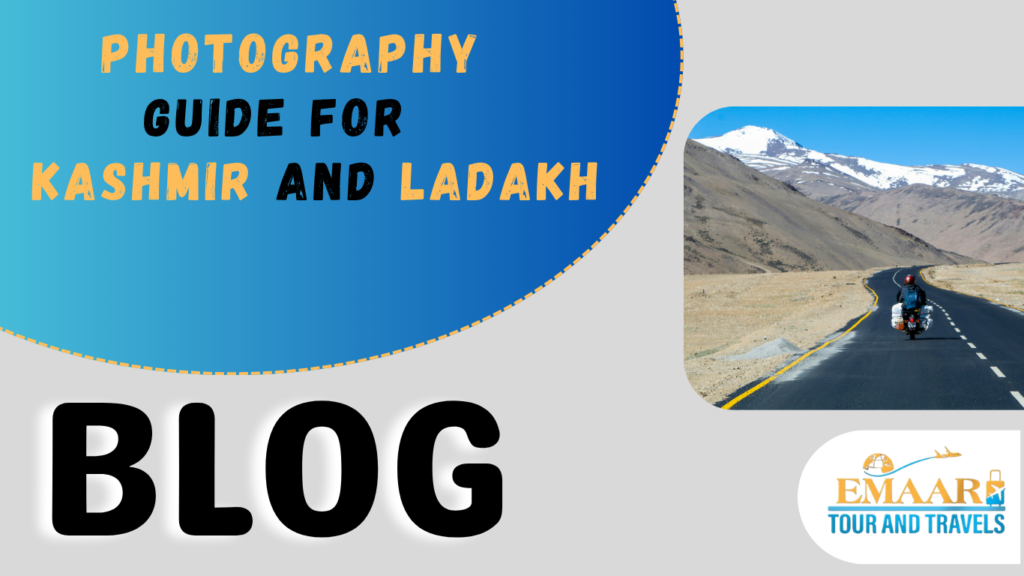
Photography Guide for Kashmir & Ladakh — The Best Spots, Light and Seasons
From the still water of Dal Lake at dawn to the cobalt silence of Pangong at first light — a complete photographer’s guide to India’s most spectacular landscapes, written by people who have stood at every viewpoint in every season.
1. Why Kashmir and Ladakh Are a Photographer’s Dream
Two Landscapes That Exist Nowhere Else
Kashmir and Ladakh represent two completely different photographic worlds within two hours of each other.Kashmir offers the lush, Mughal-layered, water-reflected beauty of Dal Lake, the Chinaar avenues, and the spring tulip fields. Ladakh, by contrast, offers a high-altitude cold desert — where the absence of moisture produces a sky of almost surreal cobalt blue and a landscape of bare rock and ancient ice that looks, on a clear day, like another planet. Consequently, planning a combined photography trip to both regions means returning home with images that look as though they were taken on separate continents.
The Unique Quality of High-Altitude Light
The light in Ladakh is, unlike anything at lower elevations. At 3,500 metres and above, the atmosphere is thinner, UV levels are extreme, and shadow contrast is significantly sharper than at sea level. Furthermore, this produces a photographic quality that landscape photographers describe as “surgical” — colours are more saturated, blues are deeper, and the line between shadow and highlight is harder and cleaner than in any lowland landscape. Above all, this is why professional photographers return to Ladakh in September year after year, when the clear post-monsoon air at altitude reaches its peak transparency.
A Region for Photographers at Every Level
Importantly, neither Kashmir nor Ladakh requires advanced technical skill to photograph well. Moreover, both regions reward the compact camera and the smartphone as generously as they reward the professional mirrorless body. What matters most is timing — specifically, being at the right location during the golden hour window, and understanding which season brings which kind of light. Therefore, this guide is designed equally for first-time travellers with a phone camera and for experienced photographers planning a dedicated shoot trip.
2. Best Photography Spots in Kashmir
Kashmir’s Green World — Where Soft Light Meets Still Water
Kashmir’s photography is defined by reflections, colour, and the interplay between water and mountain.The valley’s lakes and rivers act as enormous natural mirrors at dawn and dusk, doubling the drama of any scene. Furthermore, the spring and autumn seasons transform the landscape with a sequence of colours — blossom white in April, deep green in July, and molten gold in October — that gives every visit a completely different visual identity. The following spots are, in our collective experience, the finest photographic locations in the Kashmir Valley.
Dal Lake at dawn is the single most photographed scene in all of Kashmir — and it earns that status.An hour before sunrise produces a stillness on the water that is unlike any other time of day. Mist sits low, the houseboats glow amber from their interior lights, and the first shikaras cross the mirror surface leaving V-shaped wakes that trail for hundreds of metres. In addition,Himalayan peaks on the eastern horizon catch the first light while the lake remains in pre-dawn shadow — creating a natural gradient from rose-gold above to deep blue below.
Furthermore, the floating vegetable market on the western shore begins before 5:00 am and offers extraordinary candid documentary photography — traders moving between boats, produce piled high on flat-bottomed shikaras, the whole scene lit only by lanterns in the earliest minutes. Therefore, hiring a shikara from your houseboat the evening before and arranging a 4:45 am departure is, above all, the most important logistics decision a Kashmir photographer can make.
Asia’s largest tulip garden, spread across terraced hillsides above Dal Lake, opens for three to four weeks each April as approximately 1.5 million tulips bloom simultaneously in over sixty varieties. Consequently, the visual scale here is genuinely overwhelming — tier upon tier of saturated colour rising up the Zabarwan hillside, with Dal Lake and the Himalayan wall framed behind. The most effective compositions use the receding terraces as natural leading lines that draw the eye upward from the lowest beds of deep purple and red to the snow peaks above.
Moreover, overcast mornings produce the finest tulip photography — diffused light eliminates the harsh shadows that direct midday sun creates between individual flowers. In addition, arriving at opening time (typically 9:00 am) gives you 30 to 45 minutes before the garden becomes very crowded. Therefore, a weekday visit in the first two weeks of April — before peak bloom weekend crowds — is the most rewarding option for any photographer.
The Mughal Gardens along Dal Lake’s eastern shore are among the finest examples of formal Islamic garden design in the world and, in October, become Kashmir’s most spectacular autumn photography location. The Chinaar trees — a Kashmiri variety of asian plane — turn deep scarlet, amber, and gold in mid-to-late October, creating a colour saturation that is unmatched anywhere else in the valley. Furthermore, Nishat Bagh’s terraced layout, with its central water channel running down the axis toward the lake, produces natural symmetrical compositions that require almost no photographic skill to execute effectively.
In addition, the gardens open at dawn and the early morning light, before the tour buses arrive, allows photographers to work the formal garden geometries without people in the frame. Moreover, the reflection of the Chinaar canopy in the garden pools during October is one of the finest close-up landscape details available in all of Kashmir.
Three More Kashmir Spots Worth the Early Alarm
Pahalgam, 95 km southeast of Srinagar, offers a completely different photographic vocabulary from Dal Lake. The Lidder River valley is a landscape of rushing glacial water, pine-forested hillsides, and open meadows at 2,740 metres — and the quality of light here in the early morning, when low-angle sun catches the river spray and illuminates the pine canopy from behind, is extraordinary. Moreover, Betaab Valley and Baisaran Meadow — both accessible by pony or on foot — add alpine flower photography opportunities in May and June that have no equivalent in the rest of Kashmir.
Furthermore, Pahalgam is one of the finest locations in Kashmir for wildlife photography — the Lidder Valley is home to the endangered Hangul deer (Kashmir stag), best photographed at dawn in the quieter forest areas away from the main tourist routes. Therefore, early morning departures from your guesthouse before the day-trip visitors arrive are, above all, the most productive approach to photography in this location.
Gulmarg offers two very different photography seasons. In winter (December to March), the meadow transforms into a white bowl ringed by ice-laden pines and snow-heavy peaks — a landscape that photographs beautifully in flat overcast light as much as in golden hour. The Phase 2 Gondola at 3,979 metres provides a viewpoint above the snowline that is available year-round, where the compression of a telephoto lens against distant Himalayan peaks creates images of extraordinary spatial depth.
In summer, the meadow fills with wildflowers and the early morning light across the open bowl — with Nanga Parbat visible on a clear day on the northeastern horizon — is one of the finest wide-angle landscape opportunities in all of Kashmir. Furthermore, the ski lift infrastructure itself, seen against a deep blue winter sky or surrounded by summer green, creates strong structural compositional elements that reward photographers who look for geometry within a natural landscape.
3. Best Photography Spots in Ladakh
The Blue World — Where Altitude Changes Everything
Ladakh’s photography is defined by a sky so blue and an air so clear that every landscape image taken here looks, to eyes accustomed to lower elevations, slightly processed. It is not. that, the high-altitude environment simply removes the haze and water vapour that soften light at sea level, producing a sharpness and colour saturation that the eye takes a day or two to fully adjust to. Consequently, the primary skill in Ladakh photography is learning to work with light that is more powerful and more directional than anything you have encountered elsewhere in India.
Pangong Tso is, The most photographed location in Ladakh — and the reason is simple: its colour is genuinely extraordinary and changes throughout the day in a way that no single image fully captures. At 4,350 metres, the lake’s shallow, mineral-rich water shifts from pale grey at pre-dawn to turquoise at sunrise, deep cobalt by mid-morning, and a vivid sapphire blue in the afternoon. The overnight camp is therefore essential for any photographer — the dawn light on the water, with the surrounding peaks turning gold while the lake surface remains in shadow, creates a contrast available only to those who stayed the night.
Furthermore, September gives Pangong its deepest and most saturated blue colour of the year. In addition, the autumn light at this latitude produces a warmth in the sky tones that summer cannot match, creating a natural warm-cool contrast between sky and water that is the defining visual quality of great Pangong photography. Moreover, the western end of the lake — nearest the camp — offers foreground compositional elements (rocks, grass tufts, shorebirds) that the flat mid-lake shore does not. Therefore, walking the shore at dawn rather than shooting from a single position consistently produces stronger images.
Nubra Valley is, above all, Ladakh’s most visually surprising photography destination. Juxtaposition of sand dunes, double-humped Bactrian camels, snow-capped peaks, and apricot orchards — all within a single wide-angle frame — is available nowhere else in India. Hundar dunes in the early morning, when the low-angle light creates sharp shadow lines across the sand surface and the camels move slowly against the mountain backdrop, produce images that photographers consistently describe as among the most unexpected of any Himalayan trip.
Furthermore, the Diskit Monastery ridge viewpoint — reached by a short steep climb above the monastery — offers one of the widest and most compositionally satisfying panoramic views in all of Ladakh. The 32-metre Maitreya Buddha statue in the foreground, the valley below, the Karakoram range behind — all within a single frame at the right focal length. In addition, the apricot orchards below Diskit in April and early May add a spectacular blossom foreground that transforms the standard monastery shot into something genuinely extraordinary.
Thiksey is the monastery that most photographers working in Ladakh return to repeatedly — because the quality of photographic material it offers is extraordinarily dense in a small area. The external architecture, stacked twelve storeys up the hillside against the valley backdrop, offers strong geometric compositions from the road below at any time of day. However, the finest external light falls on the monastery’s eastern face between 6:00 and 8:30 am, when the warm golden light catches the whitewashed walls while the valley below is still in shadow.
Furthermore, the 6:30 am prayer ceremony inside the main hall — which visitors may observe quietly — offers documentary photography of extraordinary intimacy. The monks in their deep burgundy robes, the butter lamp light on ancient thangka paintings, and the sound of the long horns in the cold morning air create a multisensory experience that produces photographs impossible to stage or replicate. In addition, arrival the evening before (to photograph at sunset) and departure the morning after (to catch the dawn ceremony) is consequently the ideal structure for any photographer visiting Thiksey.
Two More Ladakh Locations That Reward the Extra Distance
Tso Moriri at 4,522 metres is the lake that Pangong was before tourism arrived. There is almost no commercial development on its shores — just a small village at Korzok, a few basic homestays, and an enormous expanse of sky-reflecting water in a wide, treeless valley surrounded by 6,000-metre peaks. Consequently, the photography here has a quality of genuine wilderness isolation that Pangong’s campsite infrastructure cannot offer. In addition, Tso Moriri is a Ramsar-designated wetland and one of the highest breeding grounds of the bar-headed goose in the world — which makes it one of the finest bird photography locations in India.
Furthermore, astrophotography at Tso Moriri is, above all, the finest available anywhere in the accessible Indian Himalayas. The absence of light pollution, the altitude, and the reflective surface of the lake combine to create conditions for Milky Way reflection photography that very few locations on earth can match. Therefore, the two-day drive from Leh is, for any serious photographer, one of the most justifiable detours available in this entire region.
Khardung La at 5,359 metres is one of the world’s highest motorable roads, and its visual signature — cascades of prayer flags against a deep sky, with the Karakoram ridgeline visible on the northern horizon — is one of the most recognisable images in Himalayan photography. The summit is most photogenic in the morning before midday clouds build on the ridgeline. Furthermore, the descent toward Nubra Valley immediately below the pass provides some of the most dramatic road photography available in the region — hairpin bends visible for kilometres below, with the valley floor appearing impossibly distant.
However, staying at the summit for extended periods is physically inadvisable due to the extreme altitude. Limit your time at the pass to 10 to 15 minutes of shooting, work efficiently with your compositions pre-planned, and descend before altitude fatigue affects your concentration. Moreover, cold temperatures at the summit drain camera batteries rapidly — consequently, keeping a spare battery warm in your jacket pocket is essential for reliable operation at this elevation.
4. Golden Hour and Light Guide — When to Shoot Each Location
Understanding Golden Hour at Altitude
Golden hour at altitude lasts longer and is more intensely coloured than at sea levEL. At 3,500 metres the atmosphere scatters less blue light, which means the warm amber tones of the low sun last significantly longer into the morning and evening. Furthermore, the shadow-to-highlight transition is sharper at altitude — which creates a window of exceptional drama immediately after sunrise and immediately before sunset that experienced photographers time their entire Ladakh schedules around. Therefore, structuring your daily itinerary around these two windows is the single most important photography decision you can make.
Golden Hour Windows by Location and Season
| Location | Dawn Window | Dusk Window | Peak Season Light | Notes |
|---|---|---|---|---|
| Dal Lake, Srinagar | 5:15–7:00 AM (summer) · 6:30–8:00 AM (winter) | 6:30–7:45 PM (summer) · 4:30–5:30 PM (winter) | April / October | Dawn mist adds atmosphere; overcast adds softness |
| Tulip Garden | 8:00–10:00 AM (within garden hours) | 4:00–5:30 PM (closing varies) | First two weeks of April | Overcast days give better flower saturation than direct sun |
| Mughal Gardens | 6:30–8:30 AM | 5:00–6:30 PM | Mid-October (Chinaar peak) | Morning light hits west-facing terraces at Shalimar first |
| Gulmarg Meadow | 5:30–7:30 AM (summer) | 6:00–7:30 PM (summer) | June (flowers) / Jan (snow) | Nanga Parbat visible NE — use telephoto at dawn |
| Pangong Lake | 5:00–7:00 AM | 5:30–7:00 PM | September | Overnight stay essential; colour deepens from July to September |
| Thiksey Monastery | 5:30–8:00 AM | 5:00–6:30 PM | All year; Sep–Oct for colour | East face catches first light; west face glows at dusk |
| Nubra Valley / Hundar | 5:45–7:30 AM | 5:30–7:00 PM | May (blossom) / Sep (clarity) | Camels most photogenic in early morning before heat haze |
| Tso Moriri Lake | 5:00–7:00 AM | 5:30–7:00 PM | September | Night sky reflection visible 10 PM–2 AM on clear nights |
5. Photography by Season — What Each Window Offers
Four Seasons, Four Different Visual Worlds
Each season in Kashmir and Ladakh produces a completely different set of photographic opportunities — not just different weather, but fundamentally different subjects, colours, and atmospheric conditions. Consequently, understanding what each season offers notably allows you to plan your trip around the images you most want to make, rather than arriving and discovering your timing was wrong by two weeks.
| Season | Kashmir Highlights | Ladakh Highlights | Light Quality | Recommended For |
|---|---|---|---|---|
| 🌸 Spring (Apr–May) | Tulip Garden, apricot blossom, Dal Lake mist | Nubra blossom, Pangong thaw edge, quiet passes | Sharp, cool, clear — excellent contrast | Floral macro, landscape, documentary |
| ☀️ Summer (Jun–Aug) | Gulmarg wildflowers, Pahalgam meadows, river light | All passes open, Hemis Festival, trekking | Warm, high UV, strong shadows — harsh at midday | Cultural events, adventure, wide landscape |
| 🍂 Autumn (Sep–Oct) | Chinaar gold at Mughal Gardens, Dal reflection | Deepest Pangong blue, clear sky, autumn poplars | Best of year — warm tones, crystal clarity | Landscape, astrophotography, all styles |
| ❄️ Winter (Nov–Feb) | Snow on houseboats, Chinaar silhouettes, fog | Chadar Trek ice, frozen Pangong, Losar ceremony | Diffused, moody, dramatic shadow — excellent | Monochrome, adventure, documentary |
Our Season Recommendation by Photographic Intent
For landscape and nature photography, September is the finest single month across both regions — the sky is at maximum clarity, the colours are at their warmest, and crowds are low enough for clean compositions. For cultural and documentary photography, July (Hemis Festival in Ladakh) and March (Dosmoche Festival) provide the richest material. For floral and spring photography, the last two weeks of April in Kashmir are non-negotiable. Furthermore, for astrophotography in particular, any clear night from September to November at either Pangong or Tso Moriri gives conditions that rank among the finest available anywhere in Asia.
6. Essential Gear for Kashmir and Ladakh Photography
What the Environment Demands from Your Equipment
The Kashmir and Ladakh environment places specific demands on camera equipment that differ from most other travel photography destinations. Specifically, the combination of extreme UV at altitude, sub-zero temperatures at high passes, dust on unpaved mountain roads, and the sudden transition between cold outdoor air and warm interiors all require protective measures and equipment choices that are different from standard travel photography. Furthermore, the remote location of several key sites — Tso Moriri in particular — means that equipment failure without a backup is a genuinely costly problem. Therefore, the following gear recommendations are based on this specific environment rather than general photography advice.
The Essential Kit List
The single most useful lens in both regions. Moreover, it captures the full scale of Pangong Lake, the Dal Lake reflection with foreground, and the Gulmarg meadow panorama that no telephoto can contain.
Essential for monastery architecture detail, wildlife at Pahalgam and Tso Moriri, and the compression of distant Himalayan peaks against foreground elements. Furthermore, 200mm on a Nubra camel at dawn is the definitive image of that location.
The most important single accessory for Ladakh photography. primarily, a polariser deepens the sky from blue to cobalt, eliminates surface glare on Pangong Lake, and controls the intense UV reflectance at altitude that otherwise washes out highlights.
Essential for dawn and dusk long exposures at Dal Lake, astrophotography at Tso Moriri, and low-light monastery interiors. Moreover, mountain winds at high passes can vibrate a lightweight tripod enough to ruin long exposures.
Cold temperatures dramatically reduce battery performance. Precisely, at Khardung La a standard battery may lose 40–60% of its stated capacity within 20 minutes. Keep one battery warm in an inner jacket pocket at all times and swap frequently.
Strongly recommended for Ladakh, where dust on unpaved mountain roads is pervasive and morning condensation on lenses is common. Furthermore, weather sealing protects against the rapid temperature changes between cold exterior and warm guesthouse interiors.
Ladakh’s dust environment means sensor spots accumulate rapidly, particularly when changing lenses outdoors. Moreover, carry a blower brush and sensor swabs and check for dust daily — otherwise spots appear in every blue-sky shot.
Carry at least two memory cards and back up to a portable hard drive or second card daily. Remote locations like Tso Moriri provide no recovery option if a card fails — carrying duplicates eliminates a risk that has no good solution after the fact.
7. Shooting at Altitude — Key Technical Considerations
How Altitude Physically Changes Your Photography
Altitude affects photography in ways that are not immediately obvious.The reduced atmospheric density at 3,500 metres and above means that UV radiation is significantly more intense — which bleaches highlights, reduces the effective dynamic range of any sensor, and causes overexposure in blue-sky regions that are routinely well-exposed at sea level. Furthermore, the thinner air means autofocus systems — particularly phase-detection systems — hunt more noticeably in low-contrast situations, because the reduced air density changes the refractive index of the atmosphere slightly. These are technical differences worth knowing before you arrive.
Practical Exposure Adjustments for Altitude
At altitude, specifically, expose to protect the highlights rather than the shadows. The intense UV and clean air mean that shadow recovery in post-processing is more reliable than highlight recovery — so a slightly underexposed sky that retains its deep blue detail is consistently preferable to an accurately metered shot that blows the mountain peaks to white. Moreover, using a circular polariser reduces the sky’s luminance by one to two stops, which brings the exposure difference between sky and foreground within a manageable range without needing a graduated ND filter. In addition, shooting in RAW format provides significantly more latitude for recovering shadow and highlight detail in these demanding conditions than JPEG processing allows.
Managing Your Body at Altitude While Shooting
Physical altitude effects directly impact photography quality in ways that are easy to underestimate. Mild altitude fatigue produces a slight cognitive slowing that affects composition decisions — photographs made on Day 1 in Leh are often notably less carefully composed than those made on Day 3, after the body has adjusted. Furthermore, breathlessness while shooting affects camera stability — a photographer who is slightly short of breath will produce more camera shake than at sea level, even with image stabilisation active. Therefore, taking conscious slow breaths before each shot, using a tripod wherever possible, and not rushing between locations on the first two days are as much photographic decisions as practical ones.
8. Photography Etiquette — Respectful and Responsible Practice
Why Etiquette Matters More Here Than in Most Destinations
Kashmir and Ladakh are both living, functioning communities — not outdoor studios. Notably, the monks at Thiksey are conducting genuine religious practice, not performing for photographers. The traders at Dal Lake’s floating market are running businesses, not posing for travel portraits. The nomadic Changpa herders photographed on the Changthang plateau live a physically demanding life in an extreme environment. Consequently, the way photographers behave in these spaces directly affects the welcome they receive — and the welcome that the next visitor receives after them.
Key Principles for Respectful Photography
Always ask before photographing individuals, particularly in the old city bazaars and during religious ceremonies. In most cases, a genuine smile and a gesture toward your camera is sufficient communication across the language gap. Furthermore, accept a refusal gracefully — some people, including many older people, have specific religious or personal objections to being photographed, and this right deserves full respect regardless of how good the potential image might be. In addition, never use flash photography inside monasteries or near ancient murals — the cumulative UV damage from repeated flash exposure over years degrades irreplaceable pigments in ways that are invisible in the short term but permanent.
Drone Photography — Know the Rules Before You Fly
Drone photography in Kashmir and Ladakh is a legally complex area that requires specific advance preparation. Moreover, large parts of Ladakh sit within militarily sensitive border zones where unmanned aerial vehicle (UAV) operation without clearance is prohibited by law. In Kashmir, drone use near Dal Lake, the old city of Srinagar, and military infrastructure similarly requires prior government clearance. Therefore, if you intend to bring a drone, contact the relevant district administration offices at least four to six weeks before your visit and obtain written permission before flying. Above all, do not rely on verbal assurances from hotel operators or tour agents — only written official clearance protects you legally.
9. Frequently Asked Questions — Photography in Kashmir and Ladakh
Questions Our Photography Package Guests Ask Most
📷 Plan a Photography-Focused Kashmir or Ladakh Trip
We offer photography-oriented itineraries with dawn transport to Dal Lake, overnight Pangong camps, and guide-led monastery visits timed around the best light windows. Tell us what you want to photograph — we will build the schedule around your shots.
📞 Plan Your Photography TripAbout the Author: This guide was written by the travel specialists at Emaar Tour and Travels, a Srinagar-based tour operator with over six years of experience guiding photographers through Kashmir and Ladakh — including dedicated photography tours for both amateur enthusiasts and professional clients from India and internationally. Visit us at emaartourandtravels.in to plan your photography journey.